核心服务



2026-03-19
《人工智能法案》及人工智能系统提供方的合规要求
《人工智能法案》及人工智能系统提供方的合规要求
随着《欧盟条例(EU)2024/1689》(即《人工智能法案》(AI Act))的通过,欧盟引入了一套统一的监管框架,旨在对人工智能系统在欧洲市场内的开发和使用进行规制。该项措施属于一项更为广泛的监管项目的一部分,其目标在于确保新技术的发展与基本权利保护、用户安全以及对数字市场的信任保持一致。
这一新的监管框架并非仅适用于在欧盟境内设立的公司;其适用范围同样延伸至拟提供人工智能(AI)系统的非欧盟经济运营者,只要该等系统所产生的输出在欧盟境内被使用。在此背景下,理解《人工智能法案》的运作机制及其所引入的主要合规义务,成为希望在欧洲市场开展或扩展业务的科技公司不可或缺的一项关键步骤。自该法案通过约一年半之后,现已具备条件对相关议题进行分析,并结合其实施情况引入与其适用相关的实践案例。
人工智能系统提供方的合规要求
众所周知,《人工智能法案》引入了一套基于风险导向方法的监管制度,根据人工智能系统对个人权利及社会可能产生的潜在影响对其进行分类。某些应用被认定为与欧洲价值观不相容,因此被明确禁止;而其他应用则可以在符合与透明度、安全性以及人类监督相关的特定要求的前提下予以使用。
因此,对于人工智能系统提供方而言,首要的操作步骤在于正确识别其所开发或投放市场的系统所属的风险类别。该项分类使得能够明确适用的具体义务,以及在系统投放市场前必须达到的文件记录和控制水平。
此外,法规对用于训练人工智能系统的数据质量给予了高度关注。不完整或存在偏见的数据集可能导致歧视性或不准确的结果,从而引发重大的法律后果及声誉风险。基于这一原因,该条例要求采取相应的控制措施,以确保人工智能系统在其整个生命周期内的质量和可靠性。
另一个关键要素涉及人工智能系统提供方与使用方之间的合作关系。提供方有义务提供一切必要信息,以使使用方能够履行其自身的监管义务,包括评估对其基本权利可能产生的影响。在提供方位于欧盟境外,且需要适应与其本国法律体系不同的监管标准的情形下,这种合作尤为敏感。
此外,《人工智能法案》的合规要求还需要与其他监管领域相协调,例如个人数据保护、网络安全以及知识产权保护,而上述领域在欧洲市场内均受到高度监管。对于许多公司而言,这意味着有必要对其内部流程和合同模式进行审查,并建立或完善相应的技术治理体系。
对于设立于欧盟境外的人工智能系统提供方而言,进入欧盟市场还可能需要在欧盟境内指定一名授权代表,并与欧盟层面及各成员国的监管机构进行沟通。如未能遵守相关监管要求,可能不仅会面临经济处罚,还可能遭受在欧洲境内对人工智能系统进行营销的限制或禁令。此前即曾出现类似情况,例如 DeepSeek 因被意大利数据保护机构认定在未确保符合欧盟关于透明度和隐私保护规则的情况下转移欧洲用户的个人数据,而被禁止在意大利境内运营。
结论
《人工智能法案》标志着人工智能监管领域的一个重要转折点,并要求人工智能系统提供方在管理其系统所涉及的技术风险和法律风险方面采取更加结构化的方法。合规不应被视为一项仅具形式意义的工作,而是需要在事前对系统特性进行评估,并据此对公司的组织结构和技术流程作出相应调整。
及时理解该条例的适用范围并实施适当的合规措施,有助于企业降低遭受制裁的风险,并减少进入欧洲市场过程中可能出现的延误。在一个日益强调技术问责和用户保护的环境中,稳健的合规方法不仅是一项法律义务,也可能成为人工智能领域企业建立信任并取得竞争优势的重要来源。
相关推荐
-
 《2026 年银行账簿证据法案(草案)》是推动印度银行记录领域法律适配数字化时代的重要立法尝试。该草案于 2026 年 8 月 3 日提交印度人民院审议,旨在废止并取代《1891 年银行账簿证...2026-08-31
 -
 越南的数据合规格局正进入新阶段,《个人数据保护法》(PDPL)、《网络安全法》(CSL)、《数据法》(DL)及其配套指导文件共同构建了一个日益全面的监管框架。与GDPR不同,越南的框架不仅涵盖...2026-08-20
 -
 2026年6月26日,第十四届全国人大常委会第二十三次会议表决通过新修订的《中华人民共和国商标法》(以下简称“新法”),国家主席签署第七十七号主席令予以公布,新法将自2027年1月1日起施行。...2026-08-14
 -
 埃塞俄比亚正逐渐成为国际投资者关注的非洲新兴市场之一。凭借庞大的国内市场、连接非洲与中东的重要战略位置、年轻的人口结构,以及持续推进的经济改革和市场开放政策,埃塞俄比亚在企业并...2026-08-05
 -
 新加坡吸引制造业投资的核心优势来自一套独特的制度组合:法律确定性、深度嵌入全球贸易协定网络、聚焦重点产业政策,以及一套协同运作的政府机构体系——对工业投资者而言最相关的经济发展局(EDB)、新...2026-07-31
 -
 过去十多年,埃塞俄比亚一直是非洲增长叙事的焦点——疫情前GDP年均增长接近10%。但外国投资者始终面对国有主导模式、封闭行业和长期外汇短缺的三重壁垒。如今,这一矛盾正在被从结构层面逐一打破。2026-07-31
 -
 哈萨克斯坦近期推出新的投资者签证机制,通常被称为“黄金签证”,作为其吸引外国资本和长期商业居民政策的一部分。根据新规则,外国公民如向哈萨克斯坦公司注册资本或本地公开交易证券投资不少于30万美元...2026-07-31
 -
 在全球供应链深度重构的背景下,中亚已从中国企业“走出去”的潜在替代区域,逐步转变为一个具有可验证商业价值的现实市场。到2025年,中国对中亚累计投资已超过300亿美元,其战略定位也正在快速从单...2026-07-31
 -
 埃塞俄比亚正站在变革的十字路口。这个拥有超过1.35亿人口、地处非洲之角战略要地的国家,凭借政府持续推进的经济自由化政策,已成为外商直接投资领域最受瞩目的前沿市场之一。意大利和中国投资者尤其表...2026-07-24
 -
 2026年6月6日,胡志明市内务局(HCMC DOHA)发布了第10165/SNV-VLATLĐ号公函(以下简称“第10165号公函”),就2026年上半年工伤事故报告的提交事宜提供指引。第1...2026-07-21
 -
 随着第96/2026号立法法令(“薪酬透明度法令”)于2026年6月7日生效,意大利已将关于薪酬透明度的(欧盟)2023/970号指令纳入国内法,并引入了一套旨在强化男女同工同酬或同值工作同酬...2026-07-21
 -
 阿联酋每年吸引逾300亿美元的外商直接投资。对机构投资者和跨国企业而言,在这里妥善搭建一桩并购交易,绝非细枝末节——它直接决定了是创造价值还是摧毁价值。2021年至2025年间,阿联酋的并购市...2026-07-21
 -
 2026年7月1日起,《超龄劳动者基本权益保障暂行规定》(以下简称“《暂行规定》”)正式施行。该规定由人力资源社会保障部、国家卫生健康委、应急管理部、国家税务总局、国家医保局联合出台,是我国首...2026-07-21
 -
 当法国奢侈品巨头的百年花卉图腾,遇上中国新茶饮品牌的急速扩张,商标权的保护边界与跨品类混淆的认定标准,成为这起千万级索赔诉讼的核心命题。2026年7月2日,苏州市中级人民法院作出一审判决,判令...2026-07-20
 -
 随着第96/2026号立法法令(“薪酬透明度法令”)于2026年6月7日生效,意大利已将关于薪酬透明度的(欧盟)2023/970号指令纳入国内法,并引入了一套旨在强化男女同工同酬或同值工作同酬...2026-07-13
 -
 越南的地理位置一直是其最重要的战略资产之一。该国沿东海绵延,靠近主要区域航运路线,具备成为制造业和出口枢纽的有利条件。这种潜力在其港口基础设施上体现得最为明显,过去十年间港口设施实现了大幅扩张...2026-06-25
 -
 埃塞俄比亚正快速崛起,成为非洲最具吸引力的投资热土之一。该国人口约1.36亿,人口中位年龄约19.5岁,同时位列非洲经济增速第一梯队,持续吸引跨国企业、制造厂商、基建开发企业、私募股权基金及家...2026-06-25
 -
 全球经济正处于分析师所称的“避难所悖论”中:传统的金融中心——从伦敦到法兰克福——要么停滞不前,要么在衰退边缘徘徊;与此同时,这座曾被视为沙漠幻影的城市,其发布的数据却让世界哑口无言。根据世界...2026-06-16
 -
 2026年6月1日,《国务院关于对外投资的规定》(下称“《规定》”)正式公布,并将于2026年7月1日起施行。这是中国对外投资领域的重要行政法规,也是在中国企业持续加速“走出去”的背景下,对既...2026-06-09
 -
 印度网络游戏产业已进入一个全新且变革性的监管时代。2026年5月1日,电子和信息技术部("MeitY")颁布实施了《2026年网络游戏促进与监管规则》("游戏监管规则"),从而使《2025年网...2026-06-02
 -
 人工智能(以下称“AI”)正日益影响着工作组织和工作任务的分配。这一议题不仅关乎生产效率,更涉及一项今后可能在劳动争议中愈发频繁出现的法律问题:AI在多大程度上能够构成裁撤岗位、进而解除劳动者...2026-05-29
 -
 张雪机车在WSBK赛道上的一骑绝尘,是中国高端制造业向世界发出的最强音。它证明了,在工程与技术的维度上,我们已经具备了挑战巅峰的实力。然而,冠军的奖杯刻在赛道上,企业的丰碑则建立在商业文明与法...2026-05-29
 -
 在全球市场深陷“避风港悖论”之际,迪拜仍持续重塑着经济稳定的内涵。尽管传统经济强权正面临停滞,尽管传统经济强权正面临停滞,但预计2026年阿联酋的国内生产总值(GDP)将增长5.0%,远超3....2026-05-19
 -
 2025年,东南亚的外商直接投资正进入一个全新阶段,这一阶段由全球供应链的转移、地缘政治的演变以及东盟经济体之间日益激烈的竞争共同塑造。越南、印度尼西亚、泰国和马来西亚都在争夺更大份额的高附加...2026-05-13
 -
 2026年4月27日,国家发展和改革委员会(“国家发改委”)下属外商投资安全审查工作机制办公室作出禁止投资决定,要求当事人撤销Meta对人工智能企业Manus的收购交易。此乃《外商投资安全审查...2026-05-09
 -
 印度联邦财政与公司事务部长已于2026年3月23日提出《2026公司法(修订)法案》,拟对《2013年公司法》和《2008年有限责任合伙法》进行广泛修订。该修订案旨在提升印度营商便利度、降低合...2026-04-30
 -
 近年来,近年来,中意经贸关系稳步发展,为有意在意大利投资的中国企业创造了有利环境。意大利是欧盟最大的经济体之一,也是进入更广泛欧盟市场的战略门户,尤其是在时尚、奢侈品、机械、食品饮料、物流和旅...2026-04-17
 -
 越南作为数字与高科技投资中心崛起,是当今塑造东南亚格局的最重要的经济叙事之一。尽管该国长期以来以制造业实力著称,尤其是在电子产品和纺织品领域,但过去几年出现了深刻的转变:越南不再仅仅是组装业务...2026-04-17
 -
 对许多希望打入大型、稳定且高附加值市场的中国企业来说,拓展欧洲市场是一项重要的战略举措。欧盟拥有超过4亿消费者、完善的基础设施,以及对投资和知识产权的强有力保护。然而,中国企业若要在欧洲取得成...2026-04-17
 -
 印度电子和信息技术部于2025年11月14日通过公告发布了《2025年数字个人数据保护规则》("DPDP规则")。这些规则使印度的《2023年数字个人数据保护法》("DPDP法案")得以实施,...2026-04-01
 -
 近年来,在全球时尚与运动产业版图中,“中国资本”正成为不容忽视的新力量。随着中国国内消费升级、产业链成熟和企业国际化意愿增强,从服饰到专业运动装备,从区域经营权到全球股权,中国企业以不同方式布...2026-03-24
 -
 随着全球投资重点向可持续发展方向发生深刻转变,越南正处于关键时刻。过去二十年间,该国经济的快速增长带来了新的繁荣,但也引发了亟待解决的环境挑战,需要进行结构性变革。为此,越南正推动向绿色发展模...2026-03-19
 -
 随着《欧盟条例(EU)2024/1689》(即《人工智能法案》(AI Act))的通过,欧盟引入了一套统一的监管框架,旨在对人工智能系统在欧洲市场内的开发和使用进行规制。该项措施属于一项更为广...2026-03-19
 -
-
 2025年11月21日,中央政府通过劳动与就业部发布通知,宣布实施《2019年工资法典》(下称“《工资法典》”)、《2020年劳资关系法典》(下称“《劳资关系法典》”)、《2020年职业安全、...2026-01-30
 -
 2025年10月28日,第十四届全国人大常委会第十八次会议表决通过《全国人民代表大会常务委员会关于修改〈中华人民共和国网络安全法〉的决定》。本次修订共涉及14项条款,聚焦于明确网络安全在总体国...2026-01-22
 -
 随着2026年的到来,外国投资者仍普遍将越南视为亚洲最具潜力的长期投资目的地之一。在全球供应链持续重塑的大背景下,越南凭借相对稳健的经济增长、具备竞争力的劳动力成本以及不断完善的产业体系,展现...2026-01-21
 -
 即将于2026年1月1日正式生效的《个人数据保护法(2025)》(以下简称“《个保法(2025)》”),标志着越南在隐私与个人数据保护法律框架领域实现重大发展。随着企业运营模式日益向数据驱动转...2025-12-25
 -
 近年来,意大利立法机关——尤其是在《卡塔比亚改革法案》(2022年第149号法令)出台后——在多个民法领域强化了调解与协助谈判的适用,将其列为提起诉讼的前置条件。此项立法调整让替代性争议解决机...2025-12-25
 -
 2025年9月30日,中国国务院正式发布《关于在政府采购中落实国产产品标准及相关政策的通知》(国办发〔2025〕34号,以下简称《通知》),明确政府采购中对国产产品的评审机制将发生重大调整。2025-12-05
 -
 随着全球指数提供商富时罗素(FTSE Russell)将其从前沿市场重新分类为次级新兴市场,越南的金融与经济发展即将迎来重大飞跃。该调整将于2026年9月正式生效,标志着越南融入全球资本市场的...2025-12-05
 -
 本文特别聚焦于欧盟与中华人民共和国之间的数据传输问题,探讨两套分别受《通用数据保护条例》(GDPR)和《个人信息保护法》(PIPL)所规制的法律体系。尽管这两套体系均以保护个人数据为共同目标,...2025-12-05
 -
 《越南欧盟自由贸易协定》(EVFTA)于 2020 年 8 月正式生效,这一事件成为越南经济发展进程中的关键转折点。作为欧盟与发展中国家签署的最全面贸易协定之一,该协定旨在推动贸易自由化、深...2025-09-28
 -
 为推行全面改革,印度财政部长尼尔马拉·西塔拉曼于2025年8月12日在人民院提交了《2025年破产与破产法(修正案)法案》(以下简称“修正案法案”)。这部拟议立法对印度的企业破产框架进行了重大...2025-09-23
 -
 世界贸易组织(WTO)就中国与欧盟在标准必要专利(SEP)案件中涉及的反诉禁令(ASIs)纠纷作出的仲裁裁决,在国际贸易和知识产权领域引发了广泛关注。本文将全面梳理案件DS611的整个进程,分...2025-09-16
 -
 越南已成为对游客和专业人士越来越有吸引力的目的地,这得益于其宽松的签证政策和对外籍劳工的明确规定。无论你是计划短期访问还是考虑长期工作居留,了解入境和就业要求都是至关重要的。2025-09-12
 -
 在并购(M&A)交易场景中,经常会遇到 “锁定期”(Lock-Up Period)、“共同出售权”(Tag Along)与 “强制出售权”(Drag Along)等条款,这些条款对于理解并购后...2025-09-05
 -
 印度在过去几年中实现了巨大的增长,外国投资的涌入是其重要原因之一。特别是在政府对制造业的大力推动下,外国直接投资(FDI)出现了显著增长。印度由多个邦和中央直辖区组成,其中喀拉拉邦是其中投资机...2025-08-27
 -
 印度商标制度受《1999年商标法》及《2017年商标规则》管辖。该国法律体系虽针对注册与未注册商标均提供保护,但商标注册所带来的法律效益与实践效益明显更强。未注册商标须通过普通法中的“假冒之诉...2025-08-20
 -
 越南正采取重要措施,计划在胡志明市和岘港发展国际金融中心(IFC),以确立其在全球金融格局中的关键地位。在政治局和国会的支持下,这一雄心勃勃的倡议标志着越南经济战略的重大转变,强调信誉和可持续...2025-08-07
 -
-
 2025年6月27日,中国立法机构通过了《反不正当竞争法》的第三次重大修订,新法将于2025年10月15日正式施行。此次修订针对数字经济时代涌现的新型不正当竞争行为进行了全面规制,新增8个条文...2025-07-25
 -
 德恩瑞律师事务所在由《商法》(China Business Law Journal)主办的 2025年度卓越律所大奖(China Business Law Awards 2025) 评选中,凭...2025-07-24
 -
 近日,美国企业家、前Expedia副总裁兼CEO Peter Kern 收购了意大利知名奢侈内衣品牌“La Perla”,品牌由此步入深度转型期。近年来,La Perla经历了严重的财务困境和...2025-07-11
 -
 近日消息称,ITA航空公司,作为阿利塔利亚商标的所有者,已获得罗马法院对其针对Aeroitalia商标提出的申诉的支持,法院认定后者侵犯了阿利塔利亚商标的专用使用权。该商标争议自2023年底开...2025-07-03
 -
 印度竞争委员会,简称CCI,是印度政府根据2002年竞争法设立的法定机构,旨在促进公平竞争,保护消费者利益,并确保印度市场的自由贸易。其重要性在于营造一个推动经济增长、创新和消费者福利的竞争环...2025-06-27
 -
 越南的化妆品市场虽然相对年轻,但正迅速成为东南亚最具活力的市场之一。随着国家经济的增长和生活水平的提高,消费者对个人护理和美容产品的认知和需求不断增加。2021年市场价值达到23亿美元,越南为...2025-06-25
 -
 随着全球经济格局的深度演变与国内经济的稳健增长,上海作为全球经济与金融枢纽的地位愈发凸显。凭借自贸区制度创新的持续引领,以及长三角地区庞大且富有活力的市场作为坚实支撑,上海正逐步蜕变为跨国企业...2025-06-23
 -
 在全球奢侈品行业即将迎来格局重塑的重要时刻,普拉达集团宣布将以13.6亿美元收购Capri集团旗下范思哲品牌100%股权,此举将两大意大利传奇奢侈品牌合二为一。2025-06-03
 -
 随着科技的迅速发展,客流分析已广泛应用于零售与服务行业,成为优化运营的重要工具。所谓客流分析,是指商家借助摄像头等设备收集顾客进店行为数据,并通过数据建模判断顾客的动线、停留区域等,以优化店铺...2025-05-27
 -
 伴随美国近期公布新一轮关税政策,全球市场面临经济不确定性再度升级。尽管4月9日宣布将暂缓实施该政策90日,但其潜在的执行风险依然存在。此项关税框架拟议实施10%的基准税率,并可能根据各国对美贸...2025-05-23
 -
 作为中国高质量发展标杆区域,长三角地区(以下简称“该地区”)持续保持外资集聚优势。以上海市、江苏省、浙江省和安徽省构成的空间单元,在国家发展战略中具有核心地位。截至2023年,该地区经济总量突...2025-05-21
 -
 近年来,劳动法合规已成为在越南运营的本地和外商投资企业的关注重点。确保遵守该国的劳动法规不仅是一项法律义务,对于营造透明且高效的工作环境也至关重要。在众多合规事项中,劳动纪律处理尤为敏感,因其...2025-05-14
 -
 在当前国际经贸关系日益复杂的背景下,正常国际贸易秩序日益受到冲击,合同履行中的风险与纠纷也随之增多。在国际货物贸易中,当一方严重违反合同时,《联合国国际货物销售合同公约》(以下简称“公约”)提...2025-04-30
 -
 如今正是人工智能(AI)蓬勃发展的时代,印度正致力于构建一套健全的监管体系,以推动AI技术在研究教育、工业应用、客户服务、医疗健康、自动化等领域的安全使用。与此同时,AI技术带来的法律与伦理挑...2025-04-25
 -
 越南化妆品市场被视为美妆个护领域极具潜力的行业板块,近年来持续吸引着外国投资者的关注。作为东南亚增长最快的市场之一,2023至2027年间越南化妆品零售市场复合年增长率(CAGR)预计达3.3...2025-04-16
 -
 认证电子邮箱(PEC)的申报义务主体范围已发生重要变化:从原先仅限于企业主体,扩展至涵盖公司董事。此项修订由《第207/2024号预算法》确立,自2025年1月1日起,对所有新设或已在企业登记...2025-03-28
 -
 作为中国经济发展的龙头和改革开放的前沿阵地,上海始终高度重视吸引外资工作。近期,上海市政府通过了推动经济持续回升向好一系列政策举措,同时积极响应国务院发布的《2025年稳外资行动方案》,旨在通...2025-03-25
 -
 2023年5月10日,欧洲议会和欧洲联盟(欧盟)理事会发布了关于建立碳边界调整机制(“CBAM”)的第2023/956号条例(欧盟)(“条例”),作为推进欧盟到2050年实现气候中和目标的重要...2025-03-18
 -
 《中华人民共和国劳动合同法》第十四条规定,用人单位与劳动者连续订立二次固定期限劳动合同,且劳动者没有《劳动合同法》第三十九条和第四十条第一项、第二项规定的情形,劳动者提出或者同意续订、订立劳动...2025-03-11
 -
 受地缘政治冲突、经济复苏缓慢等多重因素影响,全球跨境投资持续低迷。中国经济正从高速增长转向高质量发展,对外商投资的质量和结构提出了更高要求,同时着力于解决外资企业在华投资、经营中遇到的实际问题...2025-03-05
 -
认证电子邮箱(PEC)的申报义务主体范围已发生重要变化:从原先仅限于企业主体,扩展至涵盖公司董事。此项修订由《第207/2024号预算法》确立,自2025年1月1日起,对所有新设或已在企业登记...2025-03-01
-
 2024年2月,越南通过了新的2030-2045年建筑业发展战略,旨在推动建筑市场,特别是城市基础设施和住房市场的发展。该战略优先考虑主要城市的关键基础设施项目,并制定了富有野心的住房建设目标...2025-02-27
 -
 近日,DeepSeek在全球范围内引发热议,意大利市场亦不例外。2025年1月30日,意大利数据保护局(Garante per la protezione dei dati personali...2025-02-18
 -
 在印度进行不动产交易时,其本土法律体系对不动产转让程序设有专门规制。1882年《财产转让法》作为核心立法,系统规定了印度境内不动产流转的法律框架,涵盖各类财产转让的程序规范、法律要件及权利架构...2025-02-13
 -
 在一项备受国内外关注的决定中,中国全国人民代表大会常务委员会(全国人大)批准了一项逐步提高法定退休年龄的政策。该政策旨在应对中国人口老龄化、劳动力短缺和经济可持续性问题,预计将对中国的商业社区...2025-02-07
 -
 越南的医疗设备市场增长迅速,吸引了外国投资者和企业。这种上升趋势在2024年越南医药博览会期间非常明显,第22届博览会在胡志明市举办,第30届在河内举办,聚集了来自不同国家和地区的数百家企业,...2025-01-24
 -
 据统计,印度是世界第二大特许经营市场,每年有超过300家公司开始特许经营。目前,印度有4600家活跃的特许经营商,经营着20多万家特许经营店。从数据记录来看,区域品牌占印度特许经营行业的50%...2025-01-23
 -
 自2025年1月1日起,修订后的《中华人民共和国反洗钱法》(“《反洗钱法》”)正式生效,以应对全球金融格局的变化、数字资产的广泛使用以及对金融系统非法用途和国家安全问题的日益关注。这些变化旨在...2025-01-23
 -
 张美兰女士,万盛发控股集团公司(“万盛发”)董事长,其案件是越南历史上最重大的腐败丑闻之一。作为越南最大的房地产集团之一的负责人,该案件不仅影响到涉案企业,还引发了整个房地产市场的担忧。因此,...2025-01-10
 -
 近年来,随着中国企业积极拓展国际业务,推进其全球化战略的步伐不断加快,境外用工作为重要的人力资源配置策略,逐渐成为企业海外运营不可或缺的一部分。在实践中,中国企业为了适应不同国家和地区的市场环...2025-01-07
 -
 印度和意大利多年来发展了牢固的商业和贸易关系。2022-2023年,两国双边贸易额达142.5亿美元。意大利是印度第18大外国投资国,2000年4月至2023年9月累计FDI流入34亿美元,时...2025-01-03
 -
 在充满机遇与挑战的2024年,DP集团德恩瑞律师事务所凭借卓越的专业实力、客户的坚定信赖、持续的创新精神以及对社会的高度责任感,在法律服务领域大放异彩,荣膺了8项重量级奖项,并获得权威媒体的广...2024-12-31
 -
 2024年11月1日,商务部、中国证券监督管理委员会等六部门联合发布了《外国投资者对上市公司战略投资管理办法》(以下简称“《2024办法》”),自2024年12月2日起施行[1]。《2024办...2024-12-27
 -
 2024年10月19日晚,国务院正式公布《中华人民共和国两用物项出口管制条例》(以下简称“《条例》”),《条例》自12月1日起施行。《条例》旨在解决现行法规相对分散、管制措施不够完善等问题,本...2024-12-24
 -
 为了提高股东管理的安全性、效率和透明度,印度公司事务部(MCA)于2023年10月27日发布通知,要求私营公司必须将其股份电子化。该通知在《公司(招股说明书与证券配售)第二次修订规则,2023...2024-12-20
 -
 我们非常荣幸能够在五年的时间内,第三次获得由意大利中国理事会基金会颁发的China Award - Capital Elite。2024-12-18
 -
 根据国际特许经营协会(IFA)的数据,越南凭借其1亿人口、日益扩大的中产阶级、强劲的GDP增长以及开放的商业环境,已成为东南亚蓬勃发展的特许经营市场。2024-12-12
 -
 2024年9月,中国商务部(MOFCOM)针对PVH公司(卡尔文·克莱因和汤米·希尔费格等品牌的母公司)开展了商业活动调查,指控该公司违反了中国的正常市场交易惯例。商务部怀疑PVH在没有正当理...2024-12-05
 -
 我们骄傲地宣布DP集团-德恩瑞律师事务所的创始人兼管理合伙人代开乐律师荣获2024年度“白玉兰纪念奖”,我们为他的成就感到无比自豪,祝贺!2024-12-02
 -
 2023年8月,奢侈品时尚集团Tapestry Inc.(旗下品牌包括凯特·丝蓓、斯图尔特·韦茨曼和Coach)达成交易,以85亿美元收购Capri Holdings Limited(旗下品牌...2024-11-28
 -
 2024年11月13日,2024年东盟-中国大湾区经济合作(前海)论坛在中国深圳市前海举行。论坛主题为“技术领导,产业协同”。今年的论坛包括五个分论坛、企业交流展览和产业合作对接活动。今年是论...2024-11-20
 -
 时尚行业的竞争性和全球化使得商标保护对这一领域的企业来说愈发重要。商标不仅是区别于其他品牌的标志,也是体现品牌价值如质量、设计和传统的重要战略资产。“意大利制造”是全球公认的卓越象征,因此特别...2024-11-05
 -
 广州互联网法院于2024年9月发布的“跨境数据纠纷十大典型案例”中,某国际型酒店集团跨境传输个人信息的案例[(2022)粤0192民出6486号]被称为中国“个人信息跨境传输首案”,该案初步明...2024-10-29
 -
 意大利是外国投资感兴趣的目的地,投资者可选择的投资类型包括对初创企业和中小型企业(SMEs)的投资。在许多情况下,此类投资在回报和创新方面取得了出色的成果。然而,像任何类型的投资一样,投资初创...2024-09-28
 -
 根据越南电子商务协会(VECOM)统计,截至2024年初,越南有7,844万互联网用户,7,270万社交媒体用户(相当于越南总人口的73.3%),1.655亿移动连接(相当于越南总人口的169...2024-09-27
 -
-
 在全球化经济格局不断演变的今天,为了进一步优化营商环境,构建开放、公平、透明的市场体系,中国政府此前发布的《公平竞争审查条例》[1](以下简称“条例”)于2024年8月1日正式实施。2024-09-12
 -
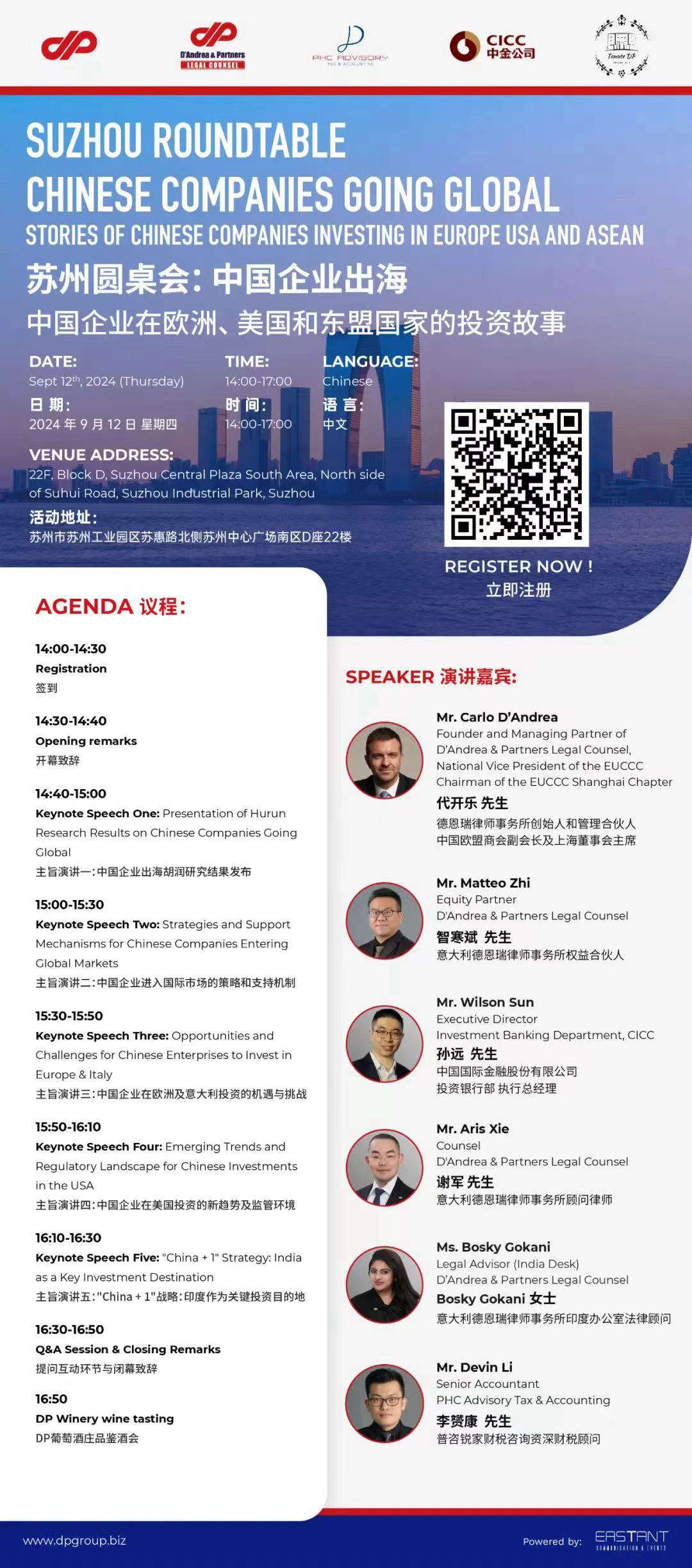 苏州圆桌会议:中国企业走向全球与我们来自德恩瑞律师事务所,普咨锐家商务咨询有限公司和中国国际金融公司(CICC)的主讲人们一起,探讨推动中国企业在欧洲、美国、东盟进行投资的挑战、策略和成功。2024-09-10
 -
 今年,中国欧盟商会联合China Macro Group (CMG) 发布报告《关于风险策略的思考:定位经济安全中的政治因素》。基于欧盟商会深度会员采访和广泛研究,报告详细阐明欧盟、中国和美国...2024-09-04


